
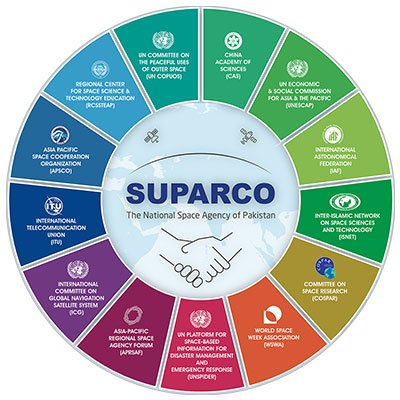
United Nations Committee on the Peaceful Uses of Outer Space (UNCOPUOS)
UNCOPUOS is an international forum facilitated by the United Nations Office of Outer Space Affairs (UNOOSA) with the mandate to discuss current and future developments and issues, and provides a forum to states to exchange views related to the outer space activities and their peaceful uses for the benefit of all humankind.
UNCOPUOS annually organizes main plenary session, Scientific & Technical Subcommittee session and Legal Subcommittee session in which all member states are invited to participate and share their position/stance on a pre-set.
Pakistan is an active member of UNCOPUOS and regularly participates in its annual sessions and working group meetings. Pakistan is also party to all five UN treaties on international space law governing the peaceful uses of outer space, namely:
- Treaty on Principles Governing the Activities of States in the Exploration and Use of Outer Space (Outer Space Treaty – 1967)
- Agreement on the Rescue of Astronauts, the Return of Astronauts and the Return of Objects Launched into Outer Space (Rescue Agreement – 1968)
- Convention on International Liability for Damage Caused by Space Objects (Liability Convention – 1972)
- Convention on Registration of Objects Launched into Outer Space (Registration Convention – 1976)
- Agreement Governing the Activities of States on the Moon and Other Celestial Bodies (Moon Agreement – 1979)

United Nations Platform for Space-based Information for Disaster Management and Emergency Response (UN-SPIDER)
United Nations Platform for Space-based Information for Disaster Management and Emergency Response (UN-SPIDER) was initiated in 2006 as new programme, with mission statement “Ensure that all countries and International and regional organizations have access to and develop the capacity to use all types of space-based information to support the full disaster management cycle”.
SACRED-SUPARCO is host to UN-SPIDER Regional Support in Pakistan since 2010.
United Nations – Economic and Social Commission for Asia and the Pacific (UN-ESCAP)
Pakistan is member of the Inter-governmental Consultative Committee (ICC) of UNESCAP since 1947 when it became member of the UN. UNESCAP is aimed to provide guidelines and advisory support for successful implementation of Regional Space Applications Programme (RESAP) among all Asia-Pacific regional countries.
SUPARCO works in close collaboration with UNESCAP for exchange of scientific and technical information, provision of data, training, consultancy, collaborative studies and joint organization of conferences, seminars, etc. It regularly attends meetings of Regional Working Groups (RWGs) on Space Science Technology and Applications (SSTA), Satellite Communications (ComSats), Remote Sensing and GIS (RS/GIS) and Meteorological Satellite (MetSat) applications etc.
In addition SUPARCO cooperates with the Information and Communications Technology and Disaster Risk Reduction (IDD) forum at UNESCAP.
Committee on Space Research (COSPAR)
COSPAR is a scientific committee of International Council for Science (ICS) established in 1958. The mandate of COSPAR is to provide services to the international space science community free from geopolitical differences. It provides a forum for sharing views, ideas, research and expertise through multilateral cooperation.
COSPAR consists of two types of members:
- National Scientific Institutions (NSIs)
- International Scientific Unions (ISUs)
SUPARCO is a member of COSPAR as National Scientific Institution since 1963. This membership helps SUPARCO stay abreast of latest space technologies and developments. SUPARCO’s engineers/scientists regularly participate in biennial sessions and present national reports and technical papers.
International Astronautical Federation (IAF)
The International Astronautical Federation (IAF) was established in 1951 to link scientists of the world on a platform to develop international cooperation in space-related activities. It has over 270 members including organizations, space agencies, scientific societies, and institutes from different countries.
IAF annually organizes International Astronomical Congress (IAC) where scientists and engineers from space industry and academia gather to share knowledge and latest developments for strengthening cooperation.
Pakistan is a member of IAF since 1985 and accrues several benefits from this forum.
International Society for Photogrammetry and Remote Sensing (ISPRS)
The International Society for Photogrammetry and Remote Sensing (ISPRS) is a non-governmental organization aimed to develop international cooperation for the advancement of photogrammetry and satellite remote sensing and their applications.
ISPRS is composed of Ordinary Members representing 100 countries. SUPARCO is an Associate Member of ISPRS since 1997.

Asia – Pacific Regional Space Agency Forum (APRSAF)
The Asia-Pacific Regional Space Agency Forum (APRSAF) was established in 1993 in Japan to enhance space activities across the Asia-Pacific region. Space agencies, inter-governmental bodies, international organizations, private companies, universities and research institutes from over 40 countries participate in APRSAF events and activities.
These include plenary sessions, working group meetings, joint projects, workshops, conferences, etc to share information in space science and related areas for the benefit of all member states.
SUPARCO has been participating in APRSAF activities since 2010. SUPARCO is member of Joint Project Team (JPT) of Sentinel Asia since 2012. SUPARCO also participates in education and awareness activities like Poster Competition, Water Rocket Competition, Cansat Competition etc.
Asia-Pacific Space Cooperation Organization (APSCO)
The Asia-Pacific Space Cooperation Organization (APSCO) is an inter-governmental non-profit organization established to promote and strengthen cooperation among the member states in the field of space science, technology and its peaceful applications. China is the host country of APSCO.
Pakistan is one of the founding members of APSCO. Other member states include Bangladesh, China, Iran, Mongolia, Peru, Thailand and Turkey. Pakistan actively participates in APSCO technical projects and capacity building programs.
Inter-Islamic Network on Space Sciences and Technology (ISNET)
ISNET is an inter-state, non-political and non-profit agency working under the ambit of the Organization of Islamic Cooperation (OIC) Standing Committee on Scientific and Technological Cooperation (COMSTECH). ISNET was established in 1987 and SUPARCO hosted the founding meeting at Karachi. The secretariat is located within SUPARCO and Chairman SUPARCO is the ex-officio President of ISNET.
Currently, ISNET has 17 member states. ISNET secured permanent observer status with UNCOPUOS (2013), became observer of GEO (2015), and in 2020 also secured observer status of APSCO.
ISNET organises international conferences, seminars, workshops and training courses. Key objectives include collaboration among OIC states, exchanging information, initiating joint projects, and providing consultancy/advisory support.
*For further updates on activities, please follow isnet.org.pk
Institute of Tibetan Plateau Research (ITP) – Chinese Academy of Sciences (CAS)
The Institute of Tibetan Plateau Research (ITP) was established by Chinese Academy of Sciences (CAS) in 2003 for geological structure and geographical environment studies of Tibetan Plateau.
ITP-CAS operates a Tibetan observation and research platform comprising a network of field stations responsible for continuous monitoring of geo-physical changes, tectonic phenomena, and land surface processes occurring on Tibetan Plateau and its impact on global environment.
Moreover, ITP-CAS provides technical support to its member states in terms of joint projects/studies and installation of monitoring stations for glacier monitoring.